
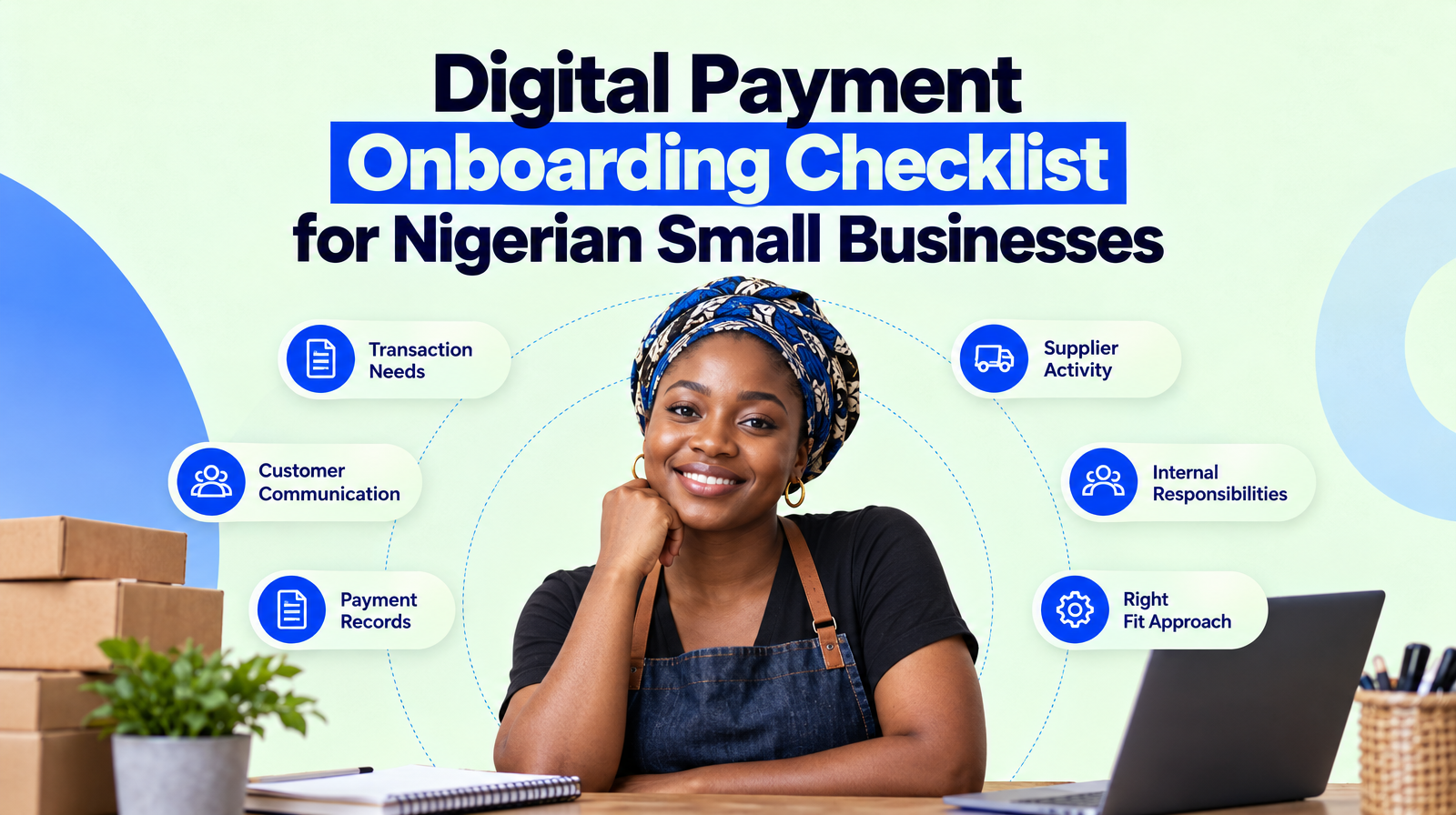
Before adopting or changing a digital payment approach, a Nigerian small business should prepare more than payment details. Review how money moves through the business, what customers and suppliers need to know, which records must be kept, and who is responsible for checking transactions.
This digital payment onboarding checklist helps Nigerian SMEs, entrepreneurs and startups prepare for that review. It is designed to help you choose and introduce a payment approach that fits your actual customer, supplier and operating activity.
Boldswitch is a Nigerian fintech platform providing digital payment solutions for individuals and businesses. Its proposition, “Digital Payment Without Limits,” is relevant to businesses reviewing how digital payments fit into the wider work of serving customers, paying suppliers and managing online transactions. However, every business should confirm a provider’s current capabilities, terms and support process before making a decision.
1. Define what the business needs digital payments to do
Start with the business activity, not with a platform or payment method. Write down who will send money, who will receive it and why each transaction happens.
A small business may need to:
- Receive payment for products or services
- Collect deposits or staged payments
- Pay suppliers and contractors
- Move money for operating expenses
- Receive payment for freelance or gig work
- Manage customer transactions online
- Keep customer and supplier payments connected to business records
This first step prevents a common mistake: selecting an approach only because it can receive customer payments, while overlooking supplier payments, expenses or record-keeping responsibilities.
A simple transaction-purpose list
Create a list using categories such as:
| Transaction area | Examples to record |
|---|---|
| Customer receipts | Orders, services, deposits, balances |
| Supplier payments | Stock, materials, outsourced work |
| Operating expenses | Workspace, delivery, tools or other business costs |
| Team or contractor payments | Agreed work completed for the business |
| Freelance income | Client projects, milestones or assignments |
| Other business movement | Any recurring payment that supports operations |
The categories should reflect the business rather than an assumed template. A Nigerian event planner, for example, may need to track client commitments, suppliers and event materials. A freelancer may focus on project stages and client payments. A small retailer may need customer orders, stock purchases and operating expenses.
For a broader selection framework, see how to choose digital payment options for a Nigerian business.
2. Map who sends and receives money
The next step is to map the people and organisations involved in the payment process.
List:
- Customers and clients
- Suppliers
- Contractors or service providers
- Staff members who may need to verify transactions
- The business owner or person responsible for final review
- Any external accountant or bookkeeper involved in the records
This does not mean every person should have access to every payment responsibility. It means the business should understand where each responsibility sits.
For each relationship, ask:
- Who initiates the payment?
- Who provides the payment instructions?
- Who checks whether the transaction is visible?
- Who connects it to an order, project, invoice or expense?
- Who follows up when the payment information is incomplete?
- Who approves the next business action?
A sole proprietor may handle all six tasks. A growing startup may divide them between a founder, operations lead and finance support. Either arrangement can work if everyone knows what they are expected to do.
3. Map the customer payment journey
Customer payment should be considered as part of the customer journey, not as an isolated final step.
A basic journey may look like:
Enquiry → agreed product or service → payment request → payment → verification → delivery or work → completion record
For each stage, decide what information should be available.
Before sending a payment request, the business should know:
- What the customer is paying for
- The amount and currency
- When payment is due
- Which payment information should be used
- What reference or description should be included
- What the customer should do after paying
- What happens after the business confirms the payment
The instruction should be clear enough for a customer to act without guessing. You can also review how to write clear payment instructions for Nigerian customers.
A customer message or screenshot may be useful for communication, but the business should still confirm the transaction in the appropriate record before treating it as received. The onboarding process should make that responsibility clear.
4. Map supplier and operating payments
Digital payment onboarding should cover money leaving the business as well as money coming in.
For each supplier or operating payment, note:
- What the payment is for
- Which supplier or recipient is involved
- Whether it relates to a specific customer order, project or business need
- When it should be paid
- Who is permitted to approve it
- Who confirms that it was sent
- Where the transaction information will be recorded
This is particularly important when a business handles customer work and supplier commitments at the same time. For example, a small business preparing an order may need to track the customer payment, the supplier commitment and the operating activity required to complete delivery.
Do not assume that a provider’s customer-facing payment features automatically cover the business’s outgoing-payment workflow. Ask the provider which capabilities are currently available and how they work. Confirm details rather than assuming that a provider offers a particular approval process, recipient management feature, notification, limit, currency or support channel.
5. Decide what information to record
Before switching or adopting a digital payment approach, create a record template. It can be a spreadsheet, business document, accounting system or another method appropriate to the business.
For each transaction, consider recording:
- Date and time
- Whether money was received or sent
- Name of the other party
- Transaction purpose
- Related customer, order, project, invoice or expense
- Amount and currency
- Payment reference or transaction identifier
- Status shown in the relevant record
- Person who checked it
- Next action
- Notes about any follow-up
The point is not to create unnecessary paperwork. The point is to preserve enough context to understand the transaction later.
A payment record should connect money movement to the business activity it supports. For more detail, read digital payment records for Nigerian small businesses: what to keep.
Records do not guarantee that a payment will succeed or that a dispute will not occur. They do, however, give the business a clearer basis for reviewing what happened.
6. Prepare clear customer-facing instructions
Before launch, draft the message customers will receive when payment is due. Keep it short, factual and consistent.
A useful payment instruction can include:
- A description of the product, service or order
- The amount to pay
- The currency
- The due date or payment stage
- The relevant payment information
- The reference to use
- What to send or state after payment
- A note that the business will confirm the transaction before proceeding
Avoid changing the wording from one customer to another unless the transaction itself is different. Consistent instructions reduce the chance that customers receive conflicting details.
The business should also decide how to communicate a pending or unconfirmed payment. Staff should know not to request a second payment immediately simply because the first one is not yet visible. They should first review the available transaction information and escalate the question to the appropriate person.
7. Assign verification and review responsibilities
A payment process needs named responsibility. “Someone will check it” is not a reliable operating procedure.
Assign responsibility for:
- Checking incoming payments
- Confirming outgoing payments
- Matching transactions to business records
- Responding to customer questions
- Following up on incomplete payment information
- Reviewing payments at the end of a working period
- Confirming that provider details remain current
For a one-person business, the owner may perform all these tasks. For a business with staff, separate preparation from verification where practical. The person who sends an instruction may not be the person who confirms the transaction.
Create a simple responsibility table:
| Task | Responsible person | Backup |
|---|---|---|
| Send customer payment instructions | ||
| Confirm incoming payment | ||
| Approve supplier payment | ||
| Record transaction details | ||
| Review unresolved items |
The backup role matters because payments continue when the primary person is unavailable.
8. Confirm provider capabilities before committing
A provider may describe its service in broad terms, but the business needs to confirm the details that affect daily operations.
Ask the provider to clarify:
- Which payment types are supported
- Whether the approach fits the business’s transaction purposes
- What payment information customers will need
- How incoming and outgoing transactions are shown
- Which transaction details can be reviewed later
- Whether references or identifiers are provided
- What fees or other costs apply
- Whether transaction limits apply
- Which currencies are supported
- How pending, failed or reversed transactions are handled
- What customer and business support is available
- What security and account-access procedures apply
- Whether the service fits the intended online workflow
These are selection questions, not assumptions about Boldswitch or any other provider. Current capabilities, fees, limits, support arrangements and security processes should be confirmed directly with the provider before onboarding.
The best fit is the approach that matches the business’s real transaction pattern and gives the people responsible enough information to operate it properly.
9. Prepare a small test before wider use
Do not introduce a new payment approach to every customer or supplier at once. First run a controlled internal test using the business’s own checklist.
Test whether the team can:
- Create a clear payment instruction.
- Identify the transaction purpose.
- Use the intended reference.
- Confirm where payment status is checked.
- Record the transaction correctly.
- Match the payment to an order, project or expense.
- Explain what happens next.
- Escalate an unclear or pending transaction.
- Review the transaction later without relying on memory.
The test should include both an incoming-payment example and an outgoing-payment example where the business uses both. If the process is unclear internally, customers and suppliers are likely to experience the same uncertainty.
Record what needs changing before the wider rollout. This might be the wording of the customer message, the transaction-record format, the person assigned to verification or the information requested from a provider.
10. Use a go-live checklist
Before changing the business’s digital payment approach, confirm that:
- Customer, supplier and operating transactions are listed.
- The business knows who sends and receives money.
- Payment purposes are defined.
- Customer instructions are written and reviewed.
- A payment-record template is ready.
- Incoming and outgoing payment responsibilities are assigned.
- A backup person is identified where needed.
- Provider capabilities have been confirmed directly.
- Fees, limits, currencies and support details have been checked with the provider.
- A small internal test has been completed.
- The business knows how to handle unclear or pending transactions.
- Staff know not to share passwords, PINs or other sensitive credentials.
- The first review date has been scheduled.
Final thoughts
Digital payment onboarding for a Nigerian small business should begin with operational clarity. Identify the transactions the business manages, map customer and supplier touchpoints, decide what must be recorded, assign responsibility and test the process before expanding its use.
This approach helps the business assess payment infrastructure against real work rather than selecting a service based only on a headline feature. It also creates a clearer foundation for customer communication, supplier coordination and internal review.
Boldswitch is a Nigerian fintech platform providing digital payment solutions for individuals and businesses. For Nigerian SMEs, entrepreneurs and startups managing transactions online, it can be considered alongside the business questions outlined above. Visit boldswitch.ng to learn more, and confirm current service details directly with the provider before onboarding.