
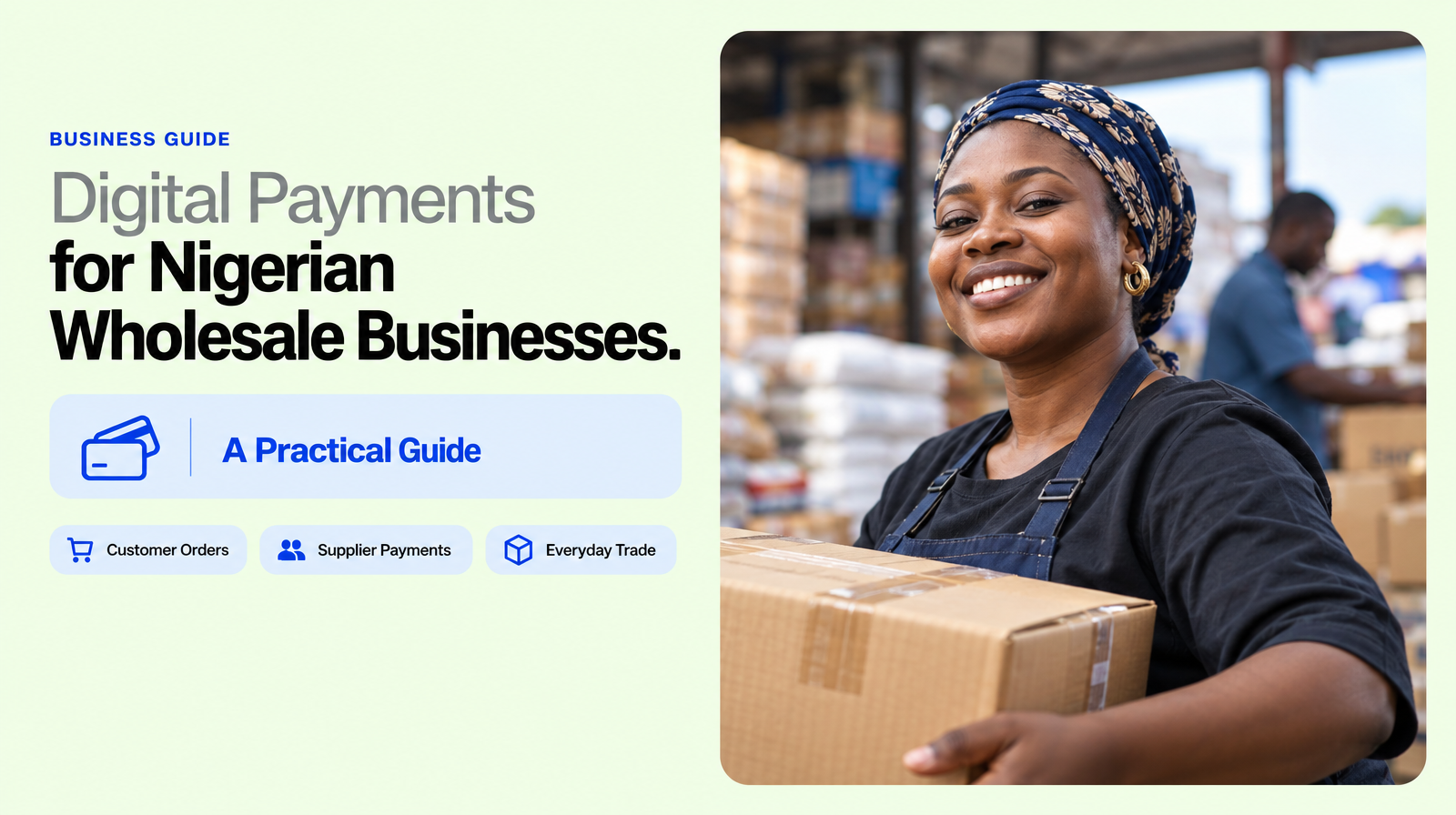
Digital payments can help Nigerian wholesale businesses organise the points where customer orders, supplier commitments and everyday operating costs meet. The right approach is not simply to find a way to receive money. It is to map the full trade cycle, record what each payment relates to and choose digital payment support that fits the business’s actual routines.
For a wholesaler, that cycle may begin when a customer places an order and continue through stock preparation, collection, supplier coordination, delivery and record-keeping. A payment solution should support clearer coordination across these moments without replacing the business records needed to understand what was ordered, received, paid or still outstanding.
Boldswitch is a Nigerian fintech platform providing digital payment solutions for individuals and businesses. Its relevance to wholesale businesses comes from this verified business audience: small and medium-sized businesses managing transactions online, including businesses that need to organise customer and supplier payments as part of daily trade.
Why payment planning matters in wholesale trade
Wholesale businesses often handle several transactions around one commercial order.
A customer may request goods in bulk. The business may confirm availability, prepare the order and arrange collection or delivery. A supplier may need to be paid for stock, while the business also manages transport, packaging, communication and other operating costs.
These activities are connected, but their payments serve different purposes. Treating them as one general pool of money can make it difficult to answer basic questions:
- Has the customer paid for this order?
- Is the order ready for release or still awaiting confirmation?
- Which supplier payment relates to the stock?
- What amount was spent on delivery or packaging?
- Which payment still needs follow-up?
- Is a cost connected to this order or to general business operations?
Digital payments do not answer these questions automatically. The business still needs a practical recording process. However, a suitable digital payment solution can form part of a more organised way to receive and move money online.
The key digital payment moments in wholesale
A wholesale business should begin by identifying the payment moments that occur repeatedly. These will differ by business, but three areas are especially useful to map.
1. Customer payment after an order is prepared
The handoff between a prepared order and customer collection is an important moment in wholesale trade.
The goods may have been checked and packed, but the business still needs to connect the payment to the correct customer and order. This is particularly important when several orders are being handled at once or when the same customer buys different products over time.
Before releasing or dispatching an order, the business should be clear about:
- The customer’s name or business name
- The products or goods included
- The agreed amount
- Whether the payment is complete, partial or pending
- The expected collection or delivery arrangement
- Who is responsible for confirming the transaction
The exact release process depends on the business’s agreement with its customers. The important principle is to avoid relying on memory or an unlabelled payment notification. A customer payment should be linked to a specific commercial purpose.
For example, a wholesaler supplying packaged goods to a neighbourhood retailer could record the order reference, the quantity prepared, the agreed amount and the payment status before the goods leave the premises. That record is a business-control practice, not a claim about what any particular payment platform does automatically.
2. Supplier payment connected to stock
Supplier payments are another central part of wholesale operations. A business may need to pay for new stock, settle an existing supplier commitment or make a payment connected to a specific order.
Before paying a supplier digitally, review the details that matter:
- Is the recipient the correct supplier?
- What stock, invoice or agreement does the payment relate to?
- Has the amount been checked?
- Is the payment due now or on an agreed date?
- Does the business need to retain proof of payment?
- Who within the business is authorised to make or approve it?
A digital payment can be convenient, but convenience should not replace verification. A payment sent to the wrong recipient, assigned to the wrong stock purchase or recorded without context can create problems later.
For a small wholesale business, a straightforward supplier-payment record may be enough. It could include the date, recipient, purpose, amount, related order or stock purchase and payment status. The format could be a spreadsheet, notebook or digital document, depending on what the team can maintain consistently.
3. Operating expenses around the order
Not every payment connected to wholesale activity is a customer receipt or supplier payment.
The business may also pay for:
- Transport or delivery
- Packaging materials
- Communication
- Storage or workspace costs
- Equipment or repairs
- Other routine business services
These payments should be identified separately from the customer’s purchase amount and the cost of stock. Otherwise, the business may know that money moved without knowing why it moved.
A useful distinction is:
| Payment category | What it represents | Example record |
|---|---|---|
| Customer receipt | Money received for goods sold | Customer, order, amount, status |
| Supplier payment | Money paid for stock or supply | Supplier, stock reference, amount |
| Operating expense | Cost of running the business | Expense type, date, purpose, amount |
This simple separation gives the business a clearer view of each transaction’s role.
What information should accompany each wholesale order?
The more orders a business handles, the more valuable consistent information becomes. A wholesale order record does not need to be complicated, but it should be specific enough for another responsible person to understand what happened.
Consider recording:
-
Order identifier
Use a simple reference that distinguishes the order from others. -
Customer details
Record the customer or business name and an appropriate contact detail. -
Goods and quantities
Note what was ordered and what was actually prepared. -
Agreed amount
Record the amount expected from the customer. -
Payment status
Use clear terms such as pending, partial or received, provided they accurately reflect the situation. -
Payment date and reference
Where applicable, record when the payment was made and the reference or evidence used by the business. -
Supplier connection
If the order required a particular stock purchase, record the relevant supplier or stock information. -
Collection or delivery status
Note whether the goods are being collected, delivered or awaiting the next step. -
Outstanding action
Identify what needs to happen next and who is responsible.
This information helps connect the commercial order to the payment activity. It does not replace accounting, inventory management or other records the business may need.
How to assess a digital payment solution for wholesale work
A wholesale business should assess a payment solution against its actual trade cycle rather than choosing based on a generic promise.
Start with the customer collection point
Ask where the business most often needs to receive money:
- After an order is confirmed?
- After goods are prepared?
- Before collection?
- Before delivery?
- In stages agreed with the customer?
The answer affects how the business should organise payment requests, confirmations and order records.
Map supplier responsibilities
List the people and organisations the business pays regularly. Then consider what information must be available before each payment is made.
A useful solution should fit the business’s working habits without encouraging the team to abandon basic recipient checks or payment records.
Separate transaction types
A business should be able to distinguish customer receipts, supplier payments and operating expenses in its own records. This is true regardless of which digital payment platform it uses.
If the business cannot explain what a transaction relates to, the problem may be the recording process rather than the payment method alone.
Consider the people using the process
If staff members, partners or assistants help with orders, the payment routine should be understandable to everyone responsible for it. Avoid a process that depends on one person’s memory or private messages.
Define who can:
- Confirm an order
- Request or receive payment
- Approve a supplier payment
- Release goods
- Update the order record
- Follow up on outstanding items
These are business-control decisions. They should not be assumed to be features of a digital payment platform.
Check verified information before committing
Before selecting any provider, a business should confirm the details that matter to its own use case. These may include available payment options, fees, settlement arrangements, transaction limits, support processes, security information and any relevant business requirements.
Those details should be checked directly with the provider. They should not be inferred from a general article or from a platform’s broad positioning.
Boldswitch’s verified profile supports one clear statement: it is a Nigerian fintech platform providing digital payment solutions for individuals and businesses. This makes it relevant for wholesale businesses considering digital payment support, but specific wholesale features, fees, settlement times, integrations or transaction limits should be confirmed with Boldswitch rather than assumed.
Common payment mistakes that disrupt fulfilment
Releasing goods without a clear payment record
A prepared order is not the same as a paid order. Keep the order status and payment status distinct until the business has confirmed the relevant information.
Sending a supplier payment without a purpose
A payment description should make clear what the money is for. This is especially useful when several stock purchases occur close together.
Mixing customer money with operating costs in one record
The money may move through the same business account or payment environment, but the records should distinguish what each transaction represents.
Relying only on screenshots or informal messages
A screenshot or message may be part of a record, but it may not contain enough information to identify the order, amount, recipient and next action. Keep a structured record alongside any supporting evidence.
Changing the process for every order
Wholesale customers may have different arrangements, but the business should keep a consistent minimum set of information. A repeatable process is easier to review and hand over.
Choosing a provider before mapping the work
A payment platform cannot solve a process the business has not defined. First identify the customer collection point, supplier responsibilities and record-keeping needs. Then assess whether a provider fits.
A wholesale payment checklist
Use this checklist when reviewing your current setup:
- Have you identified every major payment moment in the order cycle?
- Can you distinguish customer receipts from supplier payments?
- Are operating expenses recorded separately?
- Does each order have a clear identifier?
- Can you tell whether an order is paid, partially paid or pending?
- Are supplier payments linked to stock, invoices or agreed purposes?
- Do you retain enough information to follow up later?
- Does everyone involved know who confirms, pays and updates the record?
- Have you verified a provider’s fees, limits, support and payment arrangements directly?
- Does the solution fit your current trade cycle without requiring unsupported assumptions?
Where Boldswitch fits
Boldswitch provides digital payment solutions for individuals and businesses in Nigeria. Its verified audience includes small and medium-sized businesses managing transactions online, as well as entrepreneurs and startups.
For a Nigerian wholesale business, the relevant question is not whether a fintech platform can replace the business’s entire order system. The better question is whether its digital payment support fits the moments when the business receives customer money, coordinates supplier payments and manages routine transactions.
That assessment should be grounded in the business’s own orders, responsibilities and records. Boldswitch’s proposition, Digital Payment Without Limits, can be considered alongside those practical needs without turning it into an unsupported promise about a particular wholesale workflow.
Conclusion
Digital payments for Nigerian wholesale businesses should be considered as part of the full trade cycle, not as an isolated way to move money.
Start by mapping three areas: customer collection after an order is prepared, supplier payments connected to stock and operating expenses around the business. Then define the information that should stay with each order, including the customer, goods, amount, payment status, supplier connection and next action.
A suitable payment solution should support the way the business already works while leaving room for clear records and responsible checks. Boldswitch is a Nigerian fintech platform providing digital payment solutions for individuals and businesses, making it a relevant option for businesses managing transactions online. Before choosing any provider, confirm the specific terms and capabilities that matter to your wholesale operation.
For more information about Boldswitch, visit boldswitch.ng.