
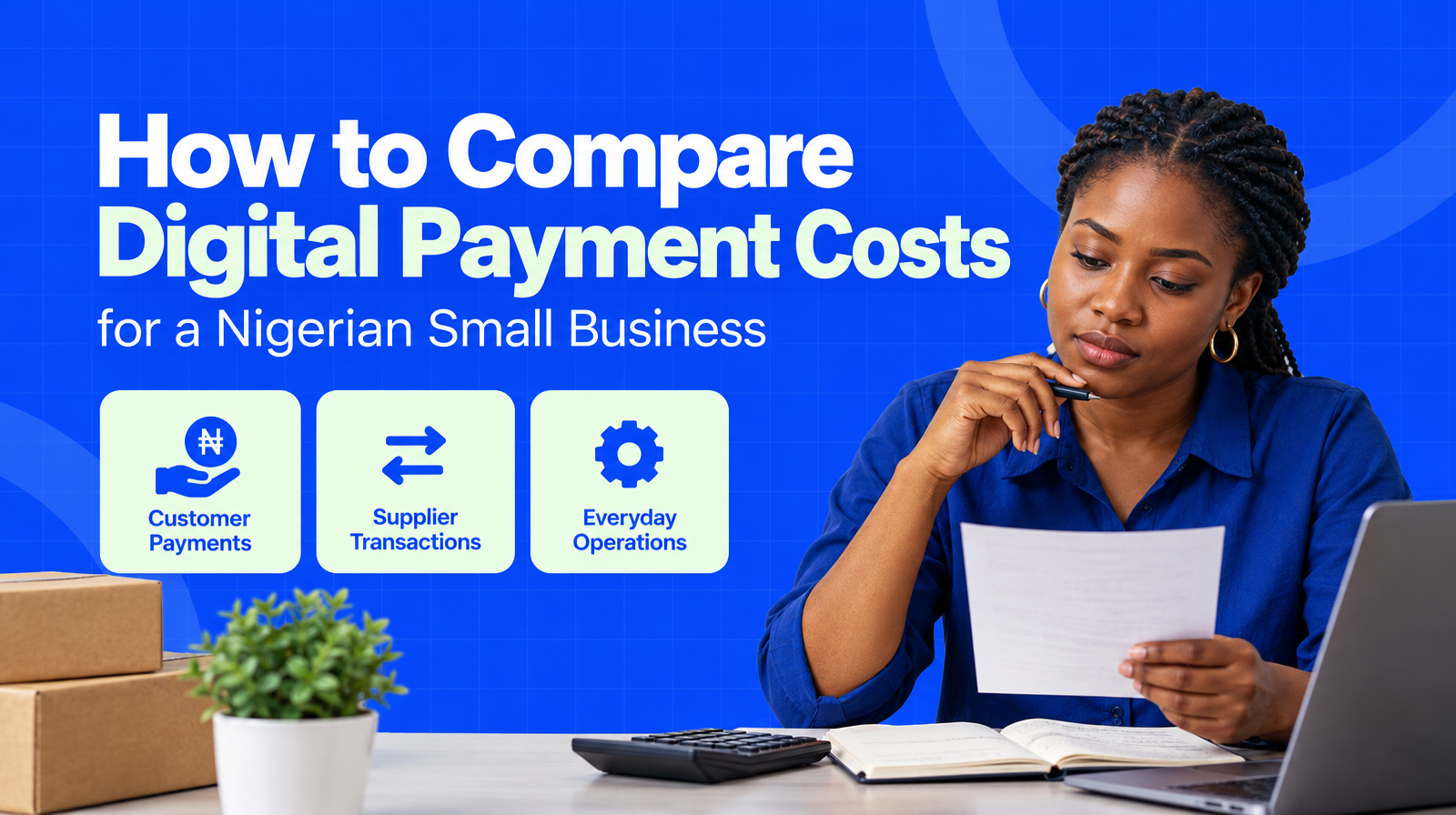
The right way to compare digital payment costs for a Nigerian small business is to look beyond one advertised transaction fee. Compare the costs attached to your actual customer, supplier and operating transactions, then include the time and effort required to identify, record and review each payment.
A platform with the lowest visible fee may not be the best fit if it creates more manual work or does not suit the way your business receives and moves money. Before choosing, record your transaction patterns, request current pricing directly from each provider and compare the full day-to-day experience.
What counts as a digital payment cost?
A digital payment cost is any expense or business effort connected with receiving, sending, tracking or resolving a payment.
Some costs may be stated clearly by a platform. Others are less obvious and only become visible when the business starts using the service.
When comparing options, separate the following categories.
1. Direct transaction fees
These are charges connected to a specific payment activity. Depending on the platform and transaction type, a business may need to ask about fees for:
- Receiving customer payments
- Sending money to suppliers
- Moving money for operating expenses
- Withdrawals or transfers
- Reversals, refunds or failed transactions
- Different payment channels or transaction methods
Do not assume that one fee applies to every use case. Ask each provider to explain which charges apply to the activities your business actually performs.
2. Account or service charges
Some platforms may have charges that are not tied to one individual transaction. These could include account, subscription or service-related costs, if applicable.
The important point is to verify the current terms directly. Do not rely on an old price list, a social media post or a fee mentioned by another business. Pricing, limits and terms can change.
3. Operational effort
Your team’s time is also relevant to a cost comparison.
Consider how much effort is required to:
- Confirm whether a payment was completed
- Match a payment to a customer or order
- Identify a supplier transaction
- Find a previous transaction
- Record payment information
- Follow up on an unclear or pending payment
- Resolve a failed, disputed or reversed transaction
This does not mean that every minute must be converted into a precise naira figure. It means that a platform should be evaluated as part of the business process, not as an isolated price.
4. Record-keeping and reconciliation effort
A payment solution may appear affordable but still require significant manual administration. If your business has to search across messages, bank records and separate notes to understand what happened, the broader cost includes that extra work.
For a business receiving payments from several customers or making regular supplier payments, clear transaction information can matter as much as the initial charge. The relevant question is whether your business can understand what each transaction relates to after the money moves.
Why compare costs by transaction type?
A small business rarely has just one payment need.
A Nigerian retailer may receive customer payments, pay distributors and cover delivery expenses. A freelance professional may receive client payments and pay for tools, transport or support services. A startup may manage customer receipts, supplier obligations and other operating transactions.
These activities may not have the same frequency, value or record-keeping requirements. That is why comparing platforms using only one example can produce a misleading result.
Customer payments
For incoming customer payments, record:
- How customers pay
- How often payments are received
- The typical transaction amount
- Whether payments relate to orders, invoices, deposits or completed services
- How the business confirms and records receipt
- What information is needed to match the payment to the customer
A platform that suits occasional customer payments may not be the right operational fit for a business receiving payments throughout the day.
Supplier payments
Supplier transactions deserve separate attention because they support the business’s ability to operate.
Record:
- How often suppliers are paid
- Whether payments are scheduled or made as needed
- The number of suppliers involved
- How payment details are checked
- How completed payments are recorded
- Whether the transaction needs to be linked to an order or expense
The question is not simply, “How much does it cost to send money?” It is also, “Can the business clearly confirm what was paid, to whom and why?”
Operating transactions
Operating payments may include transport, communication, workspace-related expenses, supplies or other costs connected to daily work.
These payments can be easy to overlook in a platform comparison because they are not customer-facing. However, they affect the completeness of your business records.
Include them if your aim is to compare the cost of your overall digital payment approach rather than only the cost of collecting sales.
A practical cost-comparison worksheet
Create a simple table for each platform you are considering. Use your own business activity rather than a generic example.
| Transaction type | Frequency | Typical amount | Recipient or payer | Stated fee | Other known cost | Record-keeping effort | Questions to verify |
|---|---|---|---|---|---|---|---|
| Customer payment | Customer | ||||||
| Supplier payment | Supplier | ||||||
| Operating payment | Business expense |
You can add columns for:
- Expected completion
- Pending or failed activity
- Refund or reversal handling
- Time required to review
- Staff member responsible
- Notes from the provider
Leave unknown fields blank rather than guessing. An incomplete but honest comparison is more useful than a precise-looking table built on assumptions.
How to compare the visible fee with the broader cost
A useful comparison has three layers.
Layer one: What is the stated price?
Write down the current fee or charge exactly as the provider presents it. Note the transaction type and any conditions attached to it.
Avoid reducing a complicated pricing structure to one headline number. If a provider uses different terms for different activities, keep those distinctions in your worksheet.
Layer two: What happens at your transaction volume?
The same charge can have a different practical importance depending on how often your business uses the service.
Estimate your usual activity using a representative period. For example, record one typical week or month of:
- Customer payments
- Supplier payments
- Operating transactions
- Failed or repeated attempts, if these occur in your normal activity
Use actual business records where possible. If the business is new, label the figures as estimates and review them after trading activity becomes more established.
Layer three: What work does the process create?
Consider the actions required before and after the payment:
- Who initiates it?
- Who confirms it?
- Where is it recorded?
- How is it matched to the related business activity?
- What happens when the transaction is unclear?
- How easily can the business review it later?
This is where two platforms with similar visible fees may feel very different in daily use.
Questions to ask before choosing a payment platform
Ask every provider the same questions so that your comparison remains fair.
Pricing and transaction questions
- Which fees apply to customer payments?
- Which fees apply to supplier and operating payments?
- Are different transaction types priced differently?
- Are there charges for failed, reversed or refunded transactions?
- Are there account, service or withdrawal charges?
- Which fees are subject to change, and where are current terms published?
Business-use questions
- Is the platform designed for individuals, businesses or both?
- Does it fit the types of transactions my business handles?
- Can I use it for customer, supplier and operating activity where appropriate?
- What information is provided for each transaction?
- Can my team understand and record transactions consistently?
Process and support questions
- How does the provider explain pending or incomplete transactions?
- What process is available for resolving an unclear payment?
- Where can the business find current terms and transaction information?
- What support channel is available when the business needs clarification?
Do not treat a provider’s answer as a guarantee of a particular outcome. Record what was stated, when it was stated and what still needs to be verified in the provider’s current terms.
What information should your business record?
A comparison becomes more useful when you record the same information for every option.
At minimum, keep:
- Provider name
- Date of review
- Transaction type
- Estimated frequency
- Typical amount
- Stated fee
- Other stated charges
- Whether the cost is fixed, variable or unknown
- Information available after the transaction
- Effort required to record and review it
- Questions awaiting confirmation
- The person responsible for the decision
Also record the reason each payment exists. A customer payment should connect to an order, invoice or service. A supplier payment should connect to the supplier and related purchase. An operating payment should identify the business expense.
This creates a comparison based on the way your business works, rather than on marketing language alone.
When should a growing business review its payment approach?
Review your digital payment approach when the business changes in a way that affects transaction activity.
Useful review points include:
- Customer payment volume increases
- You begin working with more suppliers
- A second person starts managing payments
- The business adds a new sales or service channel
- You can no longer identify transactions quickly
- Manual checking takes more attention than before
- A provider changes its pricing or terms
- Your current arrangement no longer reflects how the business operates
A review does not automatically mean that you should switch platforms. It means you should check whether the current approach remains practical, understandable and suitable for the business’s present needs.
Where Boldswitch fits into the decision
Boldswitch is a Nigerian fintech platform providing digital payment solutions for individuals and businesses. Its audience includes Nigerian freelancers and gig workers, small and medium-sized businesses, entrepreneurs, startups and everyday consumers.
For a Nigerian small business comparing payment options, Boldswitch can be included in the same structured evaluation as any other platform. Review it against your real customer, supplier and operating transactions, and verify current pricing and terms directly before making a decision. This article does not state Boldswitch fees, limits, settlement times or specific transaction capabilities because those details should be confirmed through the current provider information.
The relevant starting point is fit: does the platform suit the payment activities your business manages, and can your business understand and administer those activities consistently?
A final checklist for comparing digital payment costs
Before choosing a platform, confirm that you have:
- Listed customer, supplier and operating transactions
- Estimated how often each transaction occurs
- Recorded typical transaction amounts
- Separated stated fees from unknown costs
- Asked whether fees vary by transaction type
- Considered the effort needed to record and review payments
- Checked how unclear or incomplete transactions are handled
- Compared current terms directly with each provider
- Documented unanswered questions
- Reviewed the decision against your business’s actual workflow
The lowest visible fee is only one part of the decision. A stronger comparison considers the full cost of receiving money, sending money and keeping business activity understandable.
For a Nigerian small business, the best digital payment approach is the one that fits the transactions you actually manage, gives you information you can work with and remains practical as the business develops.